
The Truth About Gurgaon’s Housing Boom
Over the last five years Gurgaon has become Indias hottest luxury real estate market. Big projects worth ₹10 crore, ₹20 crore and even ₹100 crore are selling out fast. Developers are launching -luxury towers one after another and prices in prime areas like Golf Course Road, Golf Course Extension Road, Southern Peripheral Road (SPR) and Dwarka Expressway have grown a lot.
There’s a question thats not being asked:
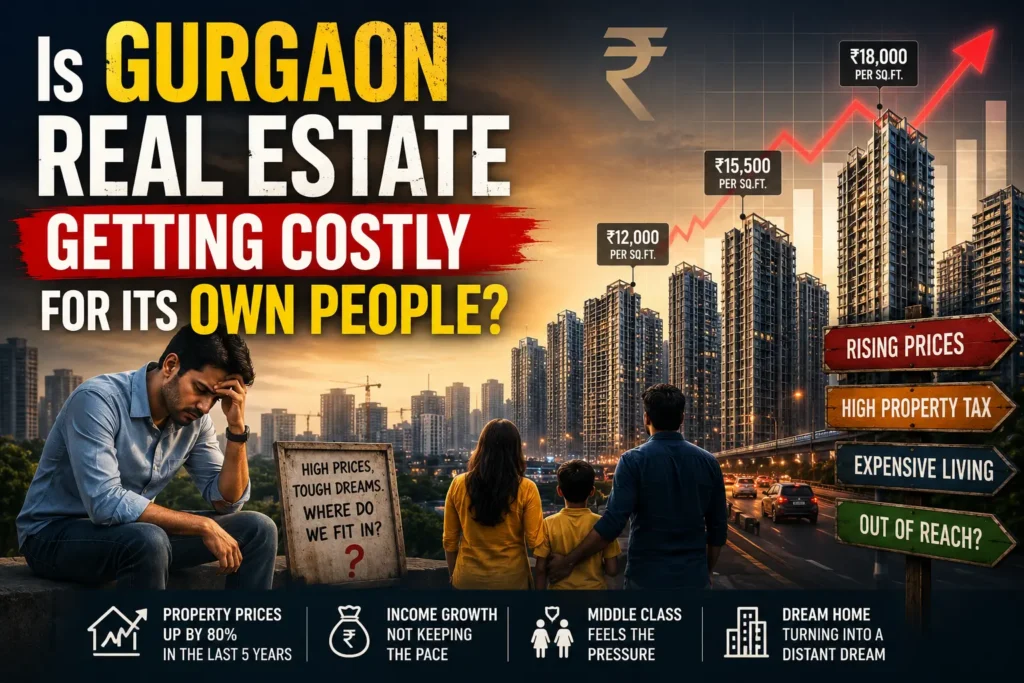
Is Gurgaon getting too expensive for its own people?
If it is what does that mean for the future of the market?
The Affordability Gap Is Growing
A years ago a middle-class professional earning ₹40-50 lakh per year could afford to buy a premium apartment in Gurgaon.
Now things are different.
Luxury apartments in locations cost between ₹20,000 and ₹35,000 per sq. Ft., with prices starting from ₹4 crore and going up to ₹10 crore.
For salaried professionals even those with high incomes these prices are hard to justify.
As a result many Gurgaon residents are being priced out of the citys premium housing market.
Who Is Buying Then?
If local salaried buyers can’t afford it who is driving this demand?
The answer is:
- Rich people
- Business owners and entrepreneurs
- Non-Resident Indians (NRIs)
- Investors looking for profits
- People upgrading from real estate gains
In many premium projects investors and wealthy buyers make up a big share of demand.
This isn’t necessarily a problem. Every global city, like Dubai, Singapore and London has a luxury segment dominated by buyers.
However it does create a risk.
The Market Is Becoming More Dependent on Wealthy Buyers
A healthy real estate market needs demand from segments:
- People who want to live in the area
- Upgraders
- Investors
- First-time homebuyers
When a market becomes heavily dependent on investors it becomes more vulnerable to changes in sentiment.
If economic growth slows down stock markets correct sharply or business confidence weakens luxury demand can cool down fast.
Prices may not crash immediately. Transaction volumes often slow down.
The Rental Math Is Also Changing
One of the realities of Gurgaon today is that rental yields haven’t increased as much as property prices.
A property purchased for ₹8 crore or ₹10 crore may generate yields of only 2.5% to 3.5%.
For buyers the investment case increasingly depends on future appreciation rather than rental income.
That works well in a rising market.
If appreciation slows down investors may start reassessing whether such expensive assets still make financial sense.
Every Luxury Market Has a Ceiling
The assumption that luxury prices can rise forever is dangerous.
Every market eventually reaches an affordability threshold where demand starts becoming concentrated among a pool of buyers.
At that point:
- Sales slow down
- Developers become more selective
- Investors become cautious
- Negotiating power shifts toward buyers
This doesn’t mean prices will fall sharply.
It simply means the market enters a phase.
Does This Mean Gurgaon Is in a Bubble?
Not necessarily.
Gurgaon still has strong advantages:
- Strong corporate ecosystem
- Presence of companies
- Growing infrastructure
- Rising wealth creation
- Increasing NRI interest
- supply of premium products
These factors continue to support long-term demand.
However believing that prices can only move in one direction is equally dangerous.
The Real Risk Isn’t a Crash
The biggest risk for Gurgaon may not be a correction.
The bigger risk could be a period where prices consolidate while incomes catch up.
In words:
Properties may continue to sell but extraordinary price appreciation may become harder to achieve if affordability keeps deteriorating.
The Bottom Line
Gurgaon remains one of Indias real estate markets.
Every booming market needs a healthy balance between wealth creation and affordability.
If local residents increasingly find themselves unable to buy homes in their city the market gradually becomes dependent, on a smaller group of rich buyers and investors.
That isn’t necessarily a problem today.
It is certainly a trend worth watching.
Because in estate the biggest risks often emerge not when everyone is fearful—but when everyone believes prices can only go up.