

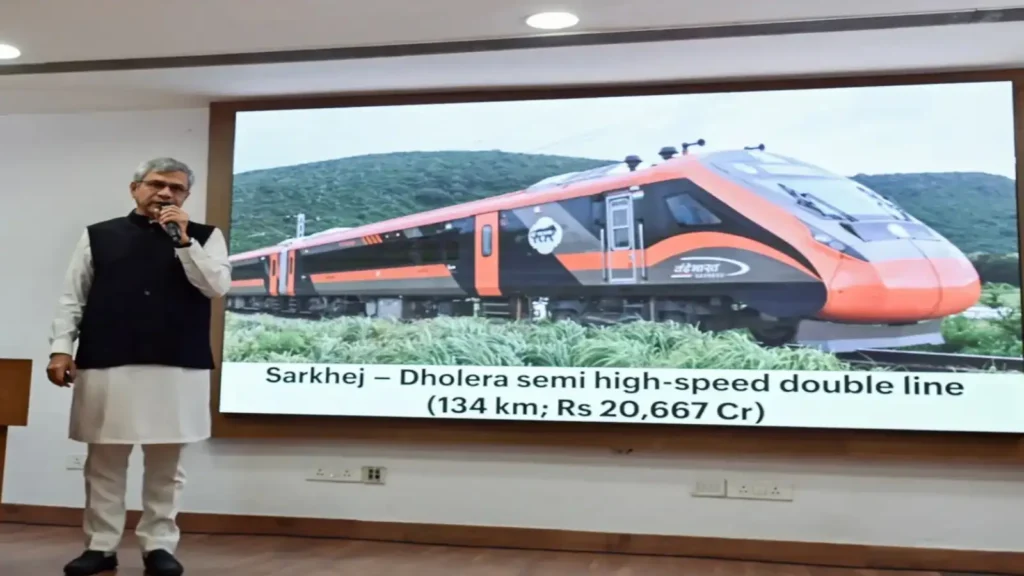
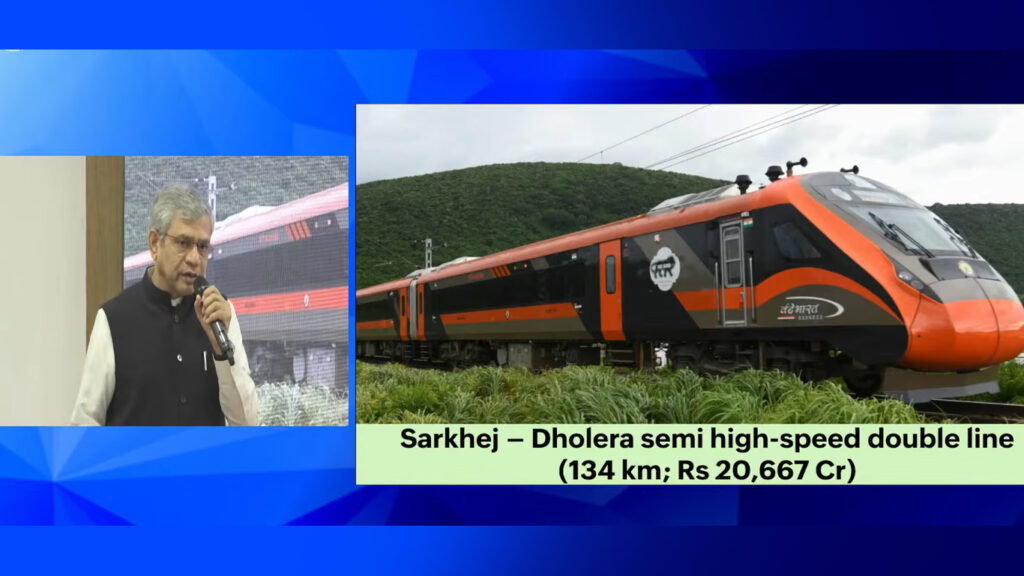
Dholera Semi-High-Speed Rail Project: India’s Union Cabinet has given its approval to a historic ₹20,667 crore semi-high-speed railway corridor between Ahmedabad/Sarkhej and Dholera — a 134 km double-line route designed for speeds up to 220 kmph. This is not just a railway project. For Dholera Smart City investors, it is the single biggest infrastructure confirmation of 2026.
Dholera Semi-High-Speed Rail Project Key Numbers at a Glance
| Detail | Info |
| Project Cost | ₹20,667 Crore |
| Corridor Length | ~134 km |
| Max Train Speed | 220 kmph |
| Track Type | Double-line broad gauge |
| Technology | India’s first indigenous design |
| Expected Completion | 2030–31 |
| Approved by | Union Cabinet — May 13, 2026 |
On May 13, 2026, the Union Cabinet gave its formal nod to the Ahmedabad–Dholera Semi-High-Speed Rail Corridor, making it India’s first indigenous broad-gauge semi-high-speed railway project. The Cabinet approval confirms a ₹20,667 crore investment into a double-line railway connecting Ahmedabad’s Sarkhej area directly to Dholera — the heart of Gujarat’s most ambitious smart city development.
For anyone tracking Dholera’s growth, or considering investing in Dholera plots, this news is a clear turning point. Every major infrastructure milestone in Dholera — the Expressway inauguration, the Tata Semiconductor plant, the airport development — has brought new investor interest and measurable plot price appreciation. The rail corridor is the biggest announcement yet.
What Exactly Is the Ahmedabad–Dholera Semi-High-Speed Rail Corridor?
The Ahmedabad–Dholera Semi-High-Speed Rail Corridor is a dedicated railway line designed as a double-line broad-gauge track running approximately 134 km from the Sarkhej area in Ahmedabad all the way to Dholera.
What makes this project special is not just speed. It is India’s first indigenously designed and built semi-high-speed corridor at this specification level. Indian Railways will use homegrown technology to build and operate trains capable of running at speeds up to 220 kmph — matching international standards while using domestic engineering.
This means lower long-term operating costs, technology ownership within India, and a clear signal to the world that India is ready to build world-class rail infrastructure for its emerging smart city corridors.
Key Facts and Project Details
- Project Name: Ahmedabad–Dholera Semi-High-Speed Rail Corridor
- Approved by: Union Cabinet of India — May 13, 2026
- Total Project Cost: ₹20,667 crore
- Route: Ahmedabad (Sarkhej) to Dholera Smart City
- Total Length: Approximately 134 km
- Track Type: Double-line broad gauge
- Design Speed: Up to 220 kmph
- Technology: Indigenous Indian design — India’s first of this kind
- Key Benefits: Passenger travel, freight movement, airport connectivity, industrial support
- Expected Completion: 2030–31
Why This Rail Corridor Is a Game-Changer for Dholera Smart City
Dholera has one of the most powerful development blueprints in Asia — covering industrial zones, a greenfield international airport, a solar park, an expressway, and a planned monorail network within the city. But the one infrastructure piece that every major investor was watching was direct, fast rail connectivity from Ahmedabad.
That wait is now officially over.
With the rail corridor approved, Dholera gets a dedicated high-frequency fast train connection to Ahmedabad — Gujarat’s commercial capital and one of India’s fastest-growing urban centres. This transforms Dholera from a “future city that’s far away” into a city that is under 45 minutes from Ahmedabad, practically speaking.
Impact on Industrial Growth and Business Travel
Dholera Special Investment Region (DSIR) is being developed as a major hub for semiconductor manufacturing, electronics, clean energy, aviation, and logistics. All of these industries need fast, reliable connectivity for executives, engineers, supply chains, and workers. The rail corridor delivers exactly that.
Companies evaluating Dholera for manufacturing or logistics operations will now see a more compelling case. Rail connectivity lowers the effective “distance” between Dholera and Ahmedabad’s business ecosystem — meaning talent can commute, goods can move faster, and business decisions can be made more confidently.
Direct Boost to Dholera International Airport Access
Dholera’s international airport is one of India’s most anticipated new airports. Once operational, it will need world-class surface connectivity to succeed. The semi-high-speed rail will provide exactly this — making the airport accessible for passengers arriving from Ahmedabad and beyond, and supporting cargo logistics for Dholera’s export-oriented industries.
“A major airport without fast rail connectivity is an airport half-built. The Dholera rail corridor completes the connectivity triangle: Expressway + Rail + Airport. That is a full-stack infrastructure offering that very few cities in India can claim.”
Strengthening Freight Corridors and Logistics
Freight movement is a critical element of Dholera’s industrial future. Whether it is semiconductor components from Tata’s fab, aviation parts from Adani-Embraer manufacturing, industrial gases from INOX Air Products, or solar panel exports — all require efficient logistics. A dedicated rail corridor with modern freight capacity directly reduces logistics costs and transit times, making Dholera’s industrial output more competitive in both domestic and global markets.
How This Compares to Other Dholera Connectivity Projects
| Infrastructure Project | Status (May 2026) | Benefit to Dholera |
| Ahmedabad–Dholera Expressway | ✅ Inaugurated 2026 | Fast road access, plot price boost |
| Dholera International Airport | 🔄 Under Development | Global air cargo & passenger hub |
| Dholera Monorail (Internal) | 🔄 Planned / In Progress | City-wide internal movement |
| Ahmedabad–Dholera Semi-High-Speed Rail | ✅ Cabinet Approved May 2026 | 220 kmph rail, 134 km corridor |
| Delhi–Mumbai Industrial Corridor (DMIC) | ✅ Active Framework | Dholera part of national growth belt |
What This Means for Dholera Plot Prices and Real Estate Investment
There is a well-documented pattern across India’s infrastructure-led cities: when a major connectivity project gets Cabinet approval, land prices in the connected region respond quickly. We saw it with the Yamuna Expressway in Noida, with the Mumbai–Pune Expressway, and most recently with the Ahmedabad–Dholera Expressway inauguration in early 2026.
The semi-high-speed rail approval is a far more significant trigger than even the expressway, because:
- Railways carry more people at lower cost — increasing the addressable population that can easily access Dholera daily
- Rail connectivity signals long-term government commitment — a ₹20,667 crore investment is a strong signal that the Dholera project will not slow down
- Passenger flow drives residential and commercial demand — workers, visitors, and businesses will need housing, offices, and services near stations
- Freight connectivity makes industrial land more valuable — reducing logistics friction increases the attractiveness of Dholera’s industrial plots
- Combined with monorail and expressway — Dholera now has a three-layer transport network that very few Indian cities outside NCR can match
Investors who entered Dholera before the Expressway inauguration saw significant appreciation. Those entering now — after the rail approval but before construction is complete — are positioned at another early entry window before the market responds fully.
The Dholera Monorail + Rail Corridor: A Complete Mobility Ecosystem
One aspect that sets Dholera apart from any other emerging city in India is the layered mobility planning. Most greenfield developments have roads and maybe one rail connection. Dholera is being planned with:
- A six-lane expressway to Ahmedabad for road travel and freight
- A semi-high-speed rail corridor for fast intercity passenger and freight travel
- An internal monorail network for movement within Dholera SIR itself
- An international airport for global air connectivity
- A seaport under planning for maritime freight access
This is not a single infrastructure bet — this is a full transport ecosystem being built simultaneously. When complete, Dholera will be India’s most connected planned city outside of the established metros.
Why 2026 Is the Right Time to Invest in Dholera Plots
Infrastructure Is Confirmed, Not Speculative
Two years ago, Dholera’s connectivity was a promise. Today, the Expressway is open, the rail corridor is Cabinet-approved, the airport is under development, and the Tata Semiconductor plant is under construction. The risk of “will this happen?” has been replaced by the reality of “it is happening.”
Prices Have Not Yet Fully Adjusted
Every major milestone causes the market to re-price Dholera land upward. But these re-pricings take time. Investors who move fast after a major announcement capture the gap between where prices are today and where they will be once the market fully digests the news.
The Industrial Ecosystem Is Generating Real Jobs
Investment attraction in Dholera has crossed a critical threshold. Tata Electronics, INOX Air Products, Adani-Embraer, ROHM Japan — these are real commitments from real companies building real facilities. Jobs follow industry. Housing demand follows jobs. Plot prices follow housing demand.