

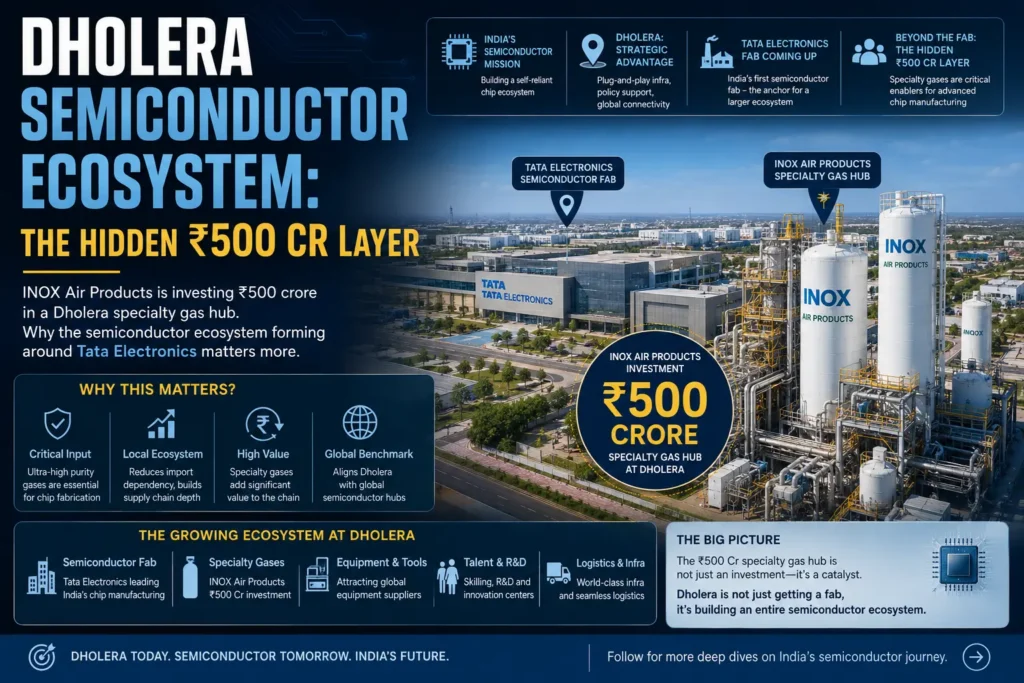
INOX Air products is investing ₹500 crore in Dholera Semiconductor Ecosystem. See why the tata electronics-led semiconductor ecosystem matters.
Dholera Semiconductor Ecosystem: The ₹500 Crore Investment Nobody Is Talking About
Dholera is no longer just a story about roads, an airport and smart-city infrastructure. It is becoming a story about what will be manufactured there — and the supply chain required to make that manufacturing possible.
INOX Air Products has committed ₹500 crore to build an Electronic Specialty Gas Hub inside Dholera SIR. On paper, a gas facility sounds far less exciting than a chip fab. In practice, it may be the more revealing development of the two.
The Dholera Semiconductor Ecosystem cannot run on chip factories alone. It needs gases, chemicals, equipment, logistics, utilities and reliable supply chains. This investment adds a piece to that puzzle that most Dholera coverage skips entirely.
INOX Air Products (INOXAP) is investing ₹500 crore in an Electronic Specialty Gas Hub inside Dholera SIR, Gujarat. The facility will supply Ultra High Purity nitrogen, oxygen, argon and hydrogen to the Dholera Semiconductor Ecosystem forming around Tata Electronics It signals that supplier industries are now positioning around Dholera’s anchor manufacturers.
What INOX Air Products Is Building in Dholera
In October 2025, INOX Air Products announced ₹500 crore of planned expenditure to expand gas-purification capacity, build import-linked supply chains for critical gases, and deploy advanced transportation and packaging solutions. As part of that plan, the company acquired a land parcel in Dholera for an Electronic Specialty Gas Hub.
The hub is intended to manufacture and supply Ultra High Purity (UHP) bulk and specialty gases, including:
- Nitrogen
- Oxygen
- Argon
- Hydrogen
These are essential inputs for advanced semiconductor fabrication and other high-tech manufacturing.
According to reporting by The Economic Times, construction of the ₹500 crore hub has begun, with the facility intended to serve the Dholera Semiconductor Ecosystem developing around Tata Electronics in Dholera.
That distinction matters. INOXAP is not simply building another industrial facility here. It is building infrastructure that other high-value industries depend on.
Why the Dholera Semiconductor Ecosystem Needs Specialty Gases
Semiconductor fabrication involves depositing, etching, cleaning and processing materials under extremely controlled conditions. The gases used at each stage must meet demanding purity standards, because even small contamination can affect output quality. Ultra High Purity gases are therefore a hard requirement, not an optional input.
When people picture chip manufacturing, they imagine silicon wafers, cleanrooms and expensive machines.
Behind every chip is a tightly controlled process where dozens of inputs must arrive to specification, every time. Gas purity sits near the top of that list.
INOXAP’s Dholera hub is designed to supply UHP gases to semiconductor fabs and OSAT facilities, while also acting as a production and fulfilment centre for contamination-controlled delivery.
Put simply: no reliable gas supply means no reliable semiconductor manufacturing. And that is exactly why the supplier’s location matters as much as its capability.
Why Dholera? The Industrial Cluster Effect
Dholera SIR spans roughly 920 square kilometres across 22 villages, developed under the Delhi–Mumbai Industrial Corridor. Semiconductor manufacturing has become its most prominent emerging sector.
The Tata Electronics fabrication project — reported at over ₹91,000 crore — is helping build the Dholera Semiconductor Ecosystem. well beyond its own boundary walls. It needs an entire network of suppliers and supporting industries.
That produces a classic clustering pattern. Picture a fab at the centre, and the layers it pulls in around it:
| Layer | What it supplies |
| Specialty gases | UHP nitrogen, oxygen, argon, hydrogen |
| Chemicals and materials | Etchants, photoresists, cleaning agents |
| Equipment and maintenance | Tooling, calibration, servicing |
| Logistics and warehousing | ISO containers, tube trailers, storage |
| Utilities and energy | Power, water, clean utilities |
| Testing and packaging | OSAT, assembly, quality control |
The more of these layers that establish in one region, the stronger the industrial base becomes. That is the significance of the INOXAP announcement.
From a Factory to a Dholera Manufacturing Ecosystem
The most common mistake in evaluating industrial development is reading projects in isolation.
A ₹500 crore facility on its own is one thing. A ₹500 crore facility positioned to serve a much larger manufacturing ecosystem is a different signal entirely.
INOXAP describes the Dholera project as part of its strategy to become an integral component of India’s high-tech ecosystem and to build a more self-reliant supply chain for semiconductor and electronics manufacturing.
The knock-on demand extends well beyond the plant itself — industrial logistics, transportation, warehousing, engineering services, maintenance, skilled manpower, construction, equipment supply, safety services, packaging, utilities and commercial services.
This is how industrial development starts producing a multiplier effect rather than a single line item. Our analysis of industrial plots in Dholera SIR covers how allotments work across these categories.
Dholera’s Semiconductor Story Runs Deeper Than One Company
The Dholera Semiconductor Ecosystem is not built on a single announcement.
Tata Electronics is developing a major fabrication ecosystem in the region, and INOXAP’s investment is designed to serve the critical-gas requirements that come with it. The Economic Times reported specifically that the hub is intended to cater to demand from the ecosystem forming around Tata Electronics.
There is a second signal worth noting, and it predates the ₹500 crore announcement.
INOXAP was already supplying electronic specialty gases to ReNew’s solar photovoltaic cell manufacturing facility at Dholera under a long-term contract. That arrangement includes gases such as nitrous oxide, ammonia and silane, along with ISO containers and tube trailers for distribution.
So the company’s relationship with Dholera’s advanced-manufacturing base did not begin with this announcement. It began earlier, at smaller scale, and has now escalated. That progression is a more meaningful indicator than any single press release. The same pattern is visible in our coverage of Japanese companies entering Gujarat.
Why Local Supply Matters for High-Tech Manufacturing
Supply reliability is not a minor operational detail for a semiconductor fab.
A chip plant cannot absorb a delayed shipment the way a conventional factory might. Production depends on a complex network of materials arriving with exact specifications, consistently.
By locating production, fulfilment, logistics and packaging capability close to major manufacturing customers, INOXAP is building toward four specific advantages:
Faster supply. Proximity reduces dependence on long-distance transport chains.
Greater reliability. Dedicated local infrastructure makes consistent availability easier to maintain.
Supply-chain resilience. India’s semiconductor ambitions require dependable access to critical inputs rather than heavy reliance on imports.
Industrial clustering. Suppliers near major manufacturers tend to attract further companies into the same region.
That last point may matter most for Dholera’s long-term trajectory.
What This Means for Dholera Investment
The headline takeaway is not “INOX is investing ₹500 crore.”
The real takeaway is that companies have started building the supply chain around Dholera’s emerging high-tech industries.
There is a meaningful difference between a location where companies announce future plans and a location where supporting industries begin positioning themselves around those projects. The second is a far stronger development signal.
This also sits alongside genuine physical progress. According to NICDC’s official Dholera project page, the 22.54 sq km Activation Area is almost complete with trunk infrastructure in place — roads, water, power, drainage and ICT ducting built rather than planned.
Add the 109-kilometre eight-lane Ahmedabad–Dholera Expressway, the approved ₹20,667 crore semi-high-speed rail corridor, the greenfield Dholera International Airport and the Dholera solar park, and the industrial case starts resting on delivered infrastructure rather than intent.
For current market context, see ourDholera SIR plot price analysis and the latest status report.
From Smart City to Industrial Ecosystem
Dholera’s future should not be read purely through residential development or land rates. Its long-term potential is tied to industrial activity, employment, infrastructure and economic output.
Dholera Semiconductor Ecosystem supply chains add a deeper layer to that story. If more companies supplying gases, materials, equipment, logistics and engineering services establish operations here, the region gradually develops a deeper industrial base.
That produces a compounding cycle: more industries lead to more jobs, which attract more suppliers, which justify more infrastructure, which generates more economic activity, which draws more businesses.
But an important reality check belongs here. Investment announcements are not completed development. A ₹500 crore announcement does not translate into ₹500 crore of immediate economic output. Facilities have to be built and commissioned, customers have to come onboard, and the wider ecosystem needs years to mature.
The honest way to read the INOXAP project is not as a guarantee of Dholera’s success, but as concrete evidence that the region is now attracting businesses that support advanced manufacturing. Our Vision 2040 outlook sets out the longer development phasing.
What Makes This Announcement Different
Emerging industrial cities generate no shortage of announcements. What makes this one worth attention is INOXAP’s position in the value chain.
It is not the headline manufacturer. It is part of the infrastructure behind the manufacturer.
You see a semiconductor plant producing chips. Behind it sit dozens of companies supplying gases, chemicals, equipment, power, water, logistics, maintenance and technology. INOXAP is positioning itself inside one of those critical layers.
That makes this a story about industrial depth, not simply industrial scale — and depth is what separates a genuine manufacturing cluster from a collection of individual projects.
What Could Come Next in Dholera SIR
If Dholera keeps attracting semiconductor and advanced-manufacturing projects, the next phase should bring more suppliers and service providers setting up around these anchor industries.
Likely categories include specialty chemicals, industrial gases, semiconductor equipment, electronics manufacturing, logistics, warehousing, engineering, testing and packaging, renewable energy and industrial automation.
Whether those supporting industries actually arrive is what will determine Dholera’s outcome. Development is governed by the Dholera Special Investment Region Development Authority across six sanctioned town planning schemes, with the next phases opening progressively — as covered in our guide to the next TP development phase.
Frequently Asked Questions
How much is INOX Air Products investing in Dholera?
INOXAP announced ₹500 crore of planned expenditure in October 2025, covering expanded gas-purification capacity, import-linked supply chains for critical gases, and advanced transportation and packaging solutions. Part of this funds an Electronic Specialty Gas Hub on land the company acquired inside Dholera SIR.
What gases will the Dholera specialty gas hub produce?
The facility is intended to manufacture and supply Ultra High Purity bulk and specialty gases, including nitrogen, oxygen, argon and hydrogen. These are essential inputs for advanced semiconductor fabrication, and the hub will also act as a production and fulfilment centre for contamination-controlled delivery.
Why does the Dholera Semiconductor Ecosystem need specialty gases?
Semiconductor fabrication requires materials to be deposited, etched, cleaned and processed under tightly controlled conditions. The gases used at each stage must meet demanding purity standards, since even minor contamination can affect manufacturing quality. Reliable UHP gas supply is a hard requirement for any fab.
Is INOXAP already operating in Dholera?
Yes. The company was already supplying electronic specialty gases to ReNew’s solar photovoltaic cell manufacturing facility at Dholera under a long-term contract, including nitrous oxide, ammonia and silane, along with ISO containers and tube trailers. The ₹500 crore hub represents a much larger step.
What does this mean for Dholera land and industrial investment?
It signals that supplier industries are positioning themselves around Dholera’s anchor manufacturers, which is how industrial clusters typically form. It is a development indicator rather than a guarantee, and land values still depend on execution, approvals and how quickly the wider ecosystem matures.
How large is Dholera SIR?
Dholera SIR spans approximately 920 square kilometres across 22 villages in Gujarat’s Ahmedabad district, developed under the Delhi–Mumbai Industrial Corridor. Within it, the 22.54 sq km Activation Area is the most developed zone, with trunk infrastructure largely in place.
Is Dholera a good long-term investment?
Dholera sits at an earlier stage than mature Gujarat hubs, so it is generally treated as a long-horizon proposition tied to infrastructure delivery and industrial occupancy. It carries genuine execution and liquidity risk, and every investment should be assessed with independent research and professional advice.
Final Takeaway
The most interesting part of the Dholera story may not be the factories everyone can see. It could be the invisible infrastructure being built behind them.
Semiconductors require extraordinary precision. That precision requires high-purity gases. High-purity gases require specialised production and supply infrastructure. INOX Air Products is now investing ₹500 crore to build exactly that capability in Dholera.
The question is no longer whether companies will come to Dholera and strengthen the Dholera Semiconductor Ecosystem.nThe more interesting question is how deep the ecosystem around them becomes.
Dholera is not just preparing for factories. It is beginning to build the supply chain that factories need.
Researching Dholera?
If you are evaluating Dholera SIR for industrial development, infrastructure exposure or real-estate opportunities, our team can walk you through zone selection, current approvals and available inventory.
Call now: +91 8448662409 or get in touch here.
Project announcements, construction timelines and investment plans can change. This article is for information only and is not investment advice. Verify current project status and approvals independently, and consult a qualified property lawyer and financial adviser before investing.